Delivering Telco Programs When Execution Flips to Suppliers
How Operators Lose Control of Their Business-Critical Programs.
When the Suppliers Run the Show
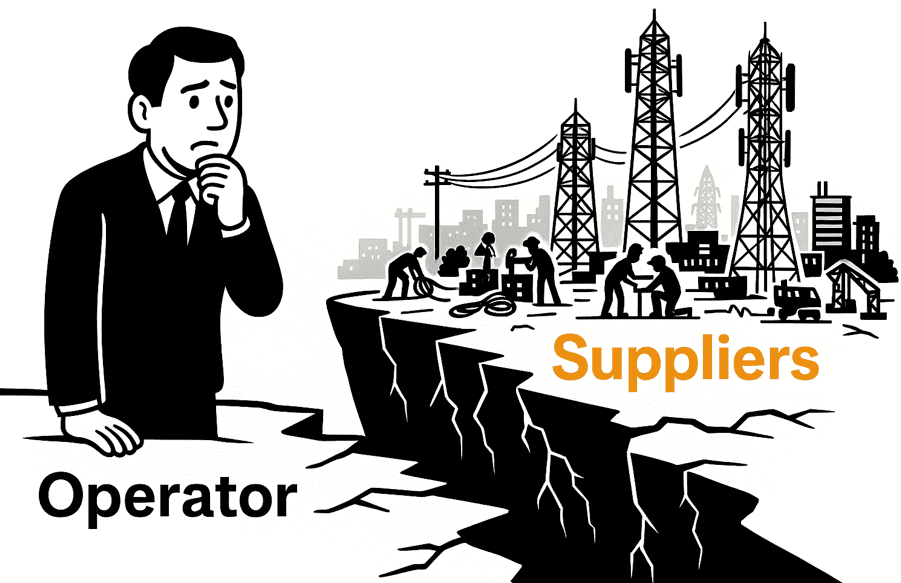
The balance of power in modern telecoms has quietly flipped. Companies still design the vision, but suppliers now control delivery – and few boards realise how exposed they’ve become.
The illusion of control is almost complete.
Executives still hold the meetings – but the real levers have moved out of reach.
But most no longer run them – and few have noticed precisely when control slipped away.
Execution power – the ability to decide what happens next, and when – has drained outward: to suppliers, integrators, and ecosystems designed to serve everyone, not you.
Which means when things go wrong, they don’t just happen out there – they happen to your customers, your numbers, and your reputation.
The Game Has Changed from Outsourcing to Orchestration
But most telco operators haven’t changed with it. They’ve mistaken distance for progress.
· Outsourcing delegates responsibility. Orchestration directs it
· Outsourcing is about handing off. Orchestration is about holding together
· Outsourcing moves work outward. Orchestration maintains centralised control, while execution is distributed
· Outsourcing scales cost savings. Orchestration scales coherence and speed
And this is not a temporary cyclical change; it’s a permanent repositioning of who holds execution power.
It’s a near-wholesale transfer, visible first in telecoms but now everywhere – banks, retailers, infrastructure owners, even government programs.
And governance hasn’t caught up – still shooting where the duck was, not where it’s going.
It’s always been a little behind, but the gap between what’s needed and what’s happening is now widening fast.
The Calm Before the Storm
Everyone feels calm. The slides are green, the milestones “on track,” and the board reports immaculate.
It’s the quiet hum of a machine already drifting off course.
The silence isn’t stability; it’s sleepwalking.
What began as selective outsourcing years ago has become near-total dependency.
Today, as much as 90 percent of execution in major infrastructure programs now sits outside the operator’s walls – run by major international suppliers, not internal teams.
In recent European rollouts, over 80 percent of field work, integration, and testing has been vendor-led, with the operator reduced to coordination and acceptance.
Internal teams are usually too small, too shallow, and too late to shape outcomes.
Control by PowerPoint
Major integrations like VodafoneThree and O2–Daisy are now being delivered by various consortia. But when almost all the execution sits outside the operator, these programs risk drifting into theatre: green slides, neat milestones, and no grip.
Committees still meet. Dashboards still flash green. Reports still reassure – but they describe a world that no longer exists.
It’s control by PowerPoint – a soothing illusion masquerading as assurance.
Boards see green boxes and tidy milestones.
What they don’t see are the late-night recoveries, the supplier dependencies, and the clunky workarounds beneath the surface.
And of course, all the early milestones will be – wait for it – green.
They always are.
It’s the corporate lullaby of every major program: green, green, green… until the day it isn’t.
By the time the truth surfaces, options have narrowed and costs have multiplied.
By then, recovery is theatre – not control; everyone acts competent while the schedule burns behind the curtain.
You would be flying the plane from the passenger seat. And that’s not a good place to be when turbulence hits.
The Knowing–Doing Gap
One hopes most operators now realise they need new orchestration and integration muscles.
Too many still cling to structures designed for a simpler age – rigid, siloed, and slow to react – and slow to learn.
Yet many still mistake process compliance for execution control.
Some try to fill the gap by hiring freelance domain experts.
Each brings depth in a narrow slice of the puzzle – but stitching them together demands another layer of management and translation.
The result? A swarm of specialists to manage before any real progress happens.
The glossy supplier slides promise senior talent and world-class delivery.
Yet, as we all know, promises scale easily; delivery talent doesn’t.
What often arrives is the “Tier 2” crew – capable, stretched, but learning on your time. A curious definition of world-class.
In practice, supplier quality varies sharply between countries, regions, and programs.
The best teams chase flagship programs; the rest are spread thin across lower-profile opportunities.
And even if you trust your suppliers – how do you know you’re getting the first team? Did anyone look past the PowerPoint CVs?
By the time you find out, the contractual machinery is already running, and your leverage has evaporated.
There’s a sizeable knowing–doing gap here – and in that gap, control quietly seeps away.
The Valium Crew
The next generation of programs – 5G Standalone, fibre densification, AI-driven networks, cloud-native cores – will punish the self-satisfied and the slow.
The Valium Crew, as one veteran program director calls them – calm, compliant, and half-asleep while risk piles up around them.
What’s needed now is the opposite: leaders with proximity, authority, and urgency – not posture, not process.
These are not linear build-outs.
They are adaptive, interdependent systems that amplify delay and expose weakness.
When execution is almost entirely outsourced, “late truth” becomes normal – reality arriving just after it’s useful – and it’s the most expensive commodity in the business.
No matter how hard operators try, they will always be the last to hear bad news – it’s human nature for the supplier base to protect itself. And it always does.
By the time the red lights flash, your options have already narrowed to three: delay, cost, or blame.
Real governance now demands proximity and immediacy, not ritual:
· Independent technical judgment close to the work
· Early-warning systems that reward truth over polish
· Integration reviews that test coherence, not cosmetics
· Sharper conversations and faster, braver decisions
Governance should detect, not simply document.
The Valium Crew never shouts; they simply drift – right up to the moment the red lights start flashing and then everyone claims no one saw it coming.
Execution Is Control
The balance of power in telecoms has flipped – make no mistake about it. When turbulence hits, some will find out too late how little control they really have.
Operators still own the networks, but suppliers now run the delivery engine.
The pivot point has already arrived.
What matters now is who learns fastest.
The operators who win will not be the ones who outsource best – they’ll be the ones who orchestrate best. And there is a big difference between the two.
A few who rebuilt small, cross-functional orchestration teams early are already seeing faster integration, cleaner handovers, and fewer contractual flashpoints.
The difference isn’t policy; it’s proximity.
Is your company close enough to what’s really happening on the ground? Not with this hands-off model, it isn’t.
Every operator knows they need those muscles – but few have them.
You can’t buy them in from the Big Four.
You have to rebuild them from within.
The Illusion of Leverage
The industry has mistaken contract clauses for control.
LDs and SLAs look tough in board papers, but they’re comfort blankets – not levers.
You can’t contract your way to control, and you can’t penalise your way back into it.
Offloading Risk – or Offloading Control?
The supplier-heavy model was meant to reduce risk – to pass complexity to those “best placed” to manage it.
It’s an attractive idea: offload risk, lighten the load.
But it rarely works that way. It feels safer right up until it isn’t.
The more control that’s given up, the more invisible the risks become – until they reappear as missed milestones, hidden dependencies, or delays that can’t be unpicked.
Dependency doesn’t erase risk; it just relocates it – further from view, deeper in the supply chain, and harder to recover once exposed.
Operators may feel lighter, but they’re also less able to steer when conditions change.
Outsourcing was meant to make execution safer. In reality, it just made it silent.
The Call
This isn’t a crisis. It’s a turning point – one that will separate operators who manage suppliers from those who are managed by them.
We’ve traded capability for convenience and called it efficiency.
We’ve confused green slides with execution grip and mistaken activity for assurance.
Every board in the industry can now see the same thing: execution power has moved outward, and with it, control.
But control isn’t lost forever – it’s simply moved. The question is whether you can bring it back.
That’s where Mentor comes in.
Mentor helps operators rebuild the orchestration muscle they’ve lost or allowed to decline – the ability to direct, integrate, and manage complex supplier ecosystems from the centre, not the edge.
We work alongside your teams to re-establish execution control where it’s been lost – inside the work itself.
We close the knowing–doing gap, cut through the noise, and restore program grip before cost, time, and credibility degrade beyond recovery.
Our clients don’t outsource control; they reclaim it.
Because in this industry, whoever owns execution wins. Everyone else just funds it.
The execution engine is already running – the only question is who’s really driving the plane?
It’s time to take back control.
That’s why Mentor exists.
To find out more, email me at david.hilliard@mentoreurope.com or call 07860 222282
About the author
David Hilliard is founder of Mentor, specialists in strategic program execution.
You can call him on 0118 359 2444 or email david.hilliard@mentoreurope.com.