The Transformation Was Broken Before the Program Began
I can almost guarantee you have seen this mistake before.
The Question
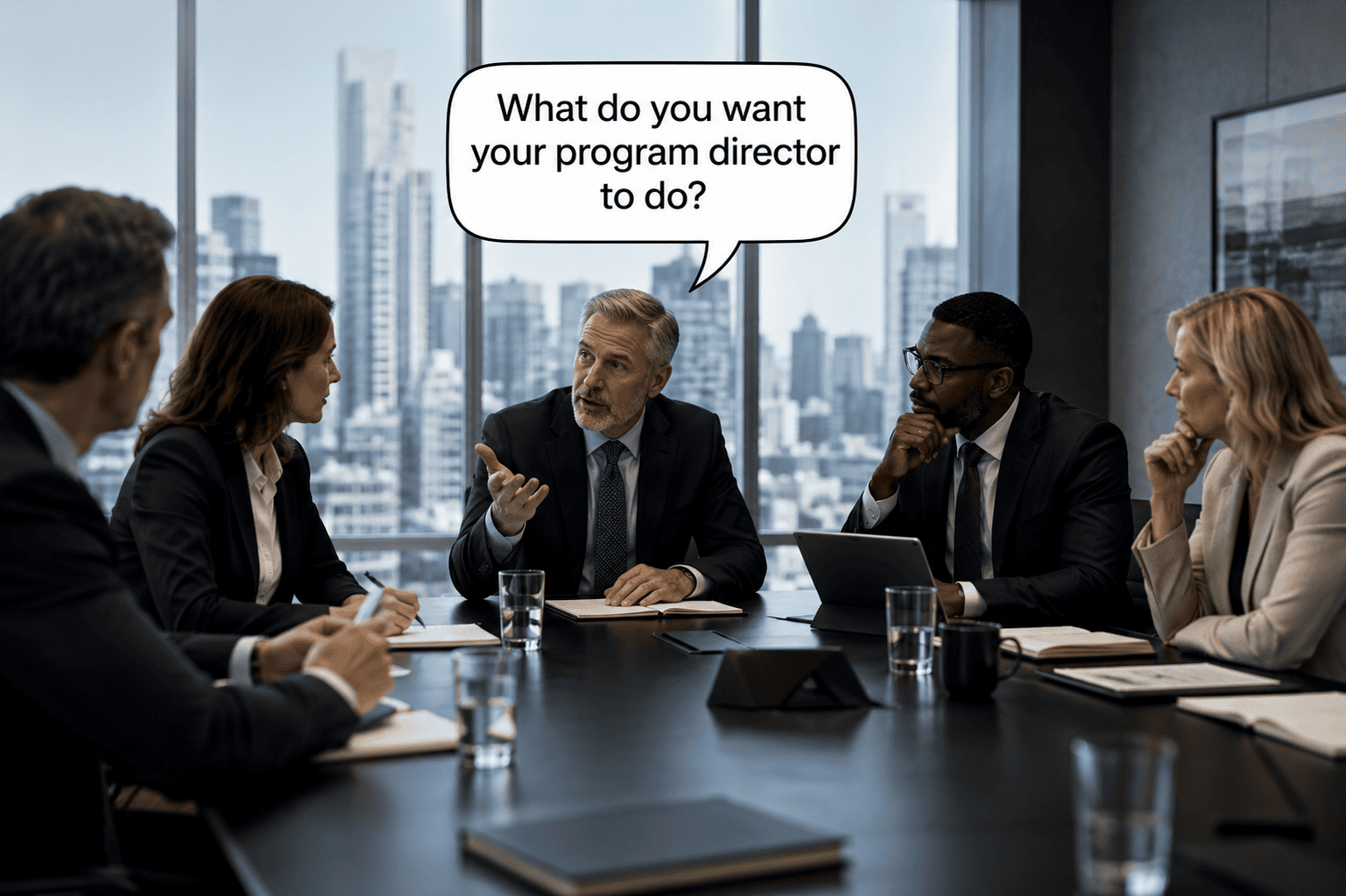
I once asked an executive team a simple question.
“What do you want your program director to do?”
One of the directors thought for a moment and said, “We’d like you to keep score. And if we’re not making the progress you think we should be making, speak sternly to us.”
This is not a joke. It is an exact quote.
That was the moment I nearly laughed. Then I realised it was serious.
This was a company with a multi-billion pound turnover, preparing to launch a major transformation. I had been invited to interview for the program director role.
These were not foolish people. They were experienced functional leaders. Most would probably have said they had transformation experience, and in a limited sense they may have been right. They had been involved in major programs, system implementations, restructures or pieces of transformation work.
But that is not the same as leading the transformation of an entire company. That is a different class of problem.
They were preparing for major surgery and looking for someone to stand outside the operating theatre with a clipboard, asking everyone to be a bit more careful.
The Setup
Most of the big decisions had already been made. The investment level had been decided. More than twenty programs had been named. The completion date had been set. Suppliers had been appointed. Additional resources had been brought in to help run the program.
So this was not a case of doing nothing. They were spending a small fortune, and there was plenty of activity.
But activity is not the same as control.
People and suppliers were around the program, but no one was really pulling them together. Each group was doing its own bit. Plans did not properly join up. Dependencies were not being forced into the open. No one was making sure the whole thing moved as one piece.
The program director was also expected to report to the group strategy director. That mattered because the role would have responsibility without any real organisational power. But the reporting line was only part of the problem.
The deeper issue was that the functional directors did not want to give up control. They wanted the transformation to happen, but they also wanted to control what the transformation director did, how fast it moved, when it happened, and how far it intruded into their own functions.
Their preferred model preserved the existing power structure. The functional directors kept control of people, budgets, priorities, pace and decisions. A program layer was placed around the outside to create the impression that the transformation was being actively managed.
It was compatible with the organisation, but it was totally incompatible with the transformation.
The Comfortable Objections
At this point, the objections usually begin.
Some will say the business still has to continue running. They are right. Customers have to be served, revenue has to be protected, people cannot be pulled endlessly into transformation meetings, and the organisation cannot be turned upside down just because a major program has been approved.
That is true. No serious chief executive should create chaos in the name of transformation.
But that is not the choice.
The choice is whether the decisions, resources, dependencies and trade-offs that determine the transformation will be controlled differently from business as usual.
This is not about suspending the business. It is about creating a management model for work the existing line organisation cannot deliver by itself.
Others will say that the functional directors own the people and budgets, so they must remain in control. Again, that sounds reasonable.
Functional ownership matters. But functional ownership is not the same as ownership of the cross-functional outcome. Major transformations usually fail in the gaps between functions, suppliers, systems and decision rights.
Another argument is that a strong program director should be able to influence without formal power. Influence matters. Relationships matter. Judgement matters.
But influence is not a substitute for authority when people, money, priorities and timing are contested.
If the person accountable for the transformation has to negotiate for permission to lead it, the program is already in trouble.
Then there is the argument that governance already exists. There will be steering committees, dashboards, workstream reviews, risk logs and escalation routes. But governance that observes delay is not control. If the same issues return meeting after meeting without decisions being forced, governance is reporting the failure, not fixing it.
Finally, there is the argument that consultants bring frameworks and tick lists, when what the business really needs is practical delivery.
In this case, the leadership team had already interviewed candidates from major consultancy firms and decided they were not suitable. They seemed put off by the framework-and-tick-list approach that often comes with these assignments.
In one sense, they were right. A transformation of this scale was not going to be delivered by importing a methodology, labelling the workstreams and running a more polished governance process.
But having rejected the consultancy answer, they had not found the delivery answer. They had settled on something more familiar: coordination, meetings, minutes, reporting, escalation and action chasing. It was less polished than the consultancy version, but it had the same weakness.
It could describe the work, but it could not control it.
The Mistake
That is why the “keep score and speak sternly” answer mattered. It revealed how they saw the role.
They did not want a program director with any authority to shape and drive the transformation. In simple terms, they wanted a coordinator. Someone to organise meetings, take minutes, chase actions, report progress, apply pressure, and keep everything tidy.
Their normal pattern of play was already visible. When a program was in trouble, someone would convene a meeting. The right people would sit around the table. They would agree that the program was not where it needed to be. The phrase used was that the troubled program needed to go into “intensive care” – driven by war room protocols.
It sounded serious. In practice, it was closer to a village hall execution model: convene the meeting, record the concern, chase the actions, express disappointment when nothing moves, and then meet again.
On smaller programs, that pattern may have helped them muddle through. A bit of escalation, a bit of pressure, a few senior people in the room, and eventually the work found its way through the system.
But this transformation was different. It was substantially bigger than anything the company had tackled for more than a decade. It cut across functions, budgets, leaders, priorities, systems, suppliers and operating assumptions. It was in a different league.
This is where the execution threshold matters.
Below that threshold, the normal management model may still work. The organisation can often muddle through with meetings, minutes, escalation, action chasing and senior pressure.
Above it, the old management model had already failed the test. It cannot control the outcome.
Adding a program wrapper around it does not fix that. It simply gives the failure a more presentable set of minutes.
At that point, the management model has to be changed, not tweaked or massaged.
But they were still reaching for the below-threshold answer: find someone to coordinate, organise meetings, take minutes, keep score, chase actions, and speak sternly when people were not doing what they should.
That was never going to be enough.
The Role
They had also interviewed the internal candidate who would normally have been expected to do this kind of work. At one point, I asked him why he was not being considered for the main transformation role.
His answer was telling.
“I think the leadership team feel that I’m not strong enough to run the programs.”
That may have been true. But it may also have been the wrong diagnosis. If someone can convene, report, chase, escalate and express concern, but cannot force decisions, move resources, change priorities or reset the operating model, weakness will appear to sit with the individual.
In reality, the weakness sits in the role.
A program director in that position does not really lead the transformation. He brokers it. He asks for resources. He asks for decisions. He asks for priorities to change. He asks powerful functions to align behind work they do not fully own.
He spends his time negotiating for permission to lead the program he is supposedly accountable for.
That was not an assignment we wanted.
The Turn
I wrote a polite letter to the chief executive explaining why we were not interested in pursuing the role.
A few days later, he called and asked whether I would come back and talk to a smaller group about what would actually be required if the transformation was to succeed.
That was a very different conversation.
The chief executive was the one person who did not seem trapped by the existing model. He was prepared to break some crockery and kill off a few sacred cows if that was what the transformation required.
I returned to meet the chief executive, the group strategy director and the group HR director. This time, I was able to explain what their original scheme would mean in practice.
The program director would be accountable for delivery but dependent on voluntary cooperation. Dependencies would sit between functions with no one able to force resolution. Suppliers would continue to create their own islands of activity. Escalation would become a ritual. Meetings would multiply. Minutes would record concern. Senior people would express frustration.
And when the transformation failed to move at the speed implied by the original assumptions, the program director would become the obvious visible problem.
That conversation led to a more useful piece of work.
I was invited to carry out what today I would describe as an Independent Program Review. I could interview around thirty people across the organisation, build a proper map of the transformation as it really stood, understand the assumptions, dependencies, constraints and power lines, and then feed back to the executive team what a successful transformation would actually require from where they were.
That was the right starting point.
Evidence before commitment. Diagnosis before role design. Authority before accountability.
The Moral of the Story
This is not unusual. In many recovery exercises we have been brought into, some version of this has already happened. The organisation chooses a program director before it understands what the program director will actually need to control.
This happens when senior teams try to deliver major transformation by meddling with the existing functional execution model.
They add a program layer around the outside because it interferes less with normal business life. The functions keep their power. The line directors keep control of resources and priorities. The program director coordinates, reports, escalates and chases.
It feels much safer because it disturbs less.
But the very thing that makes it comfortable is what makes it incapable of delivering the transformation.
If your transformation is taking longer than expected, costing more than expected, consuming more senior time than expected, and still only edging forward, it may be worth asking a harder question.
Have you built a delivery model capable of changing the organisation, or have you placed a program wrapper around the existing one?
Because those are not the same thing.
A program wrapper can convene meetings, produce reports, chase actions, escalate issues and keep the room busy.
It cannot force the organisation to make the trade-offs the transformation requires. It cannot overcome a power structure that still leaves the critical decisions, resources and priorities dispersed across the same functional lines.
And it cannot deliver a transformation that the organisation is still trying to absorb without disturbing itself too much.
That is the trap.
The transformation is not failing because the program director has run out of charm.
It is failing because the organisation has asked someone to deliver change while protecting the management model that needs to change.
At that point, the program director is no longer a delivery leader.
He is a future explanation.
The failure was built into the transformation before the program began
It could never succeed.
About the author
David Hilliard is Founder of Mentor, execution specialists in strategic program execution.