
Supplier Mobilisation: The Most Underrated Risk to Program Execution
Suppliers do at least half the heavy lifting
Getting business-critical programs right is hard enough inside your own walls. But there’s a crucial piece that doesn’t get nearly enough attention: supplier mobilisation.
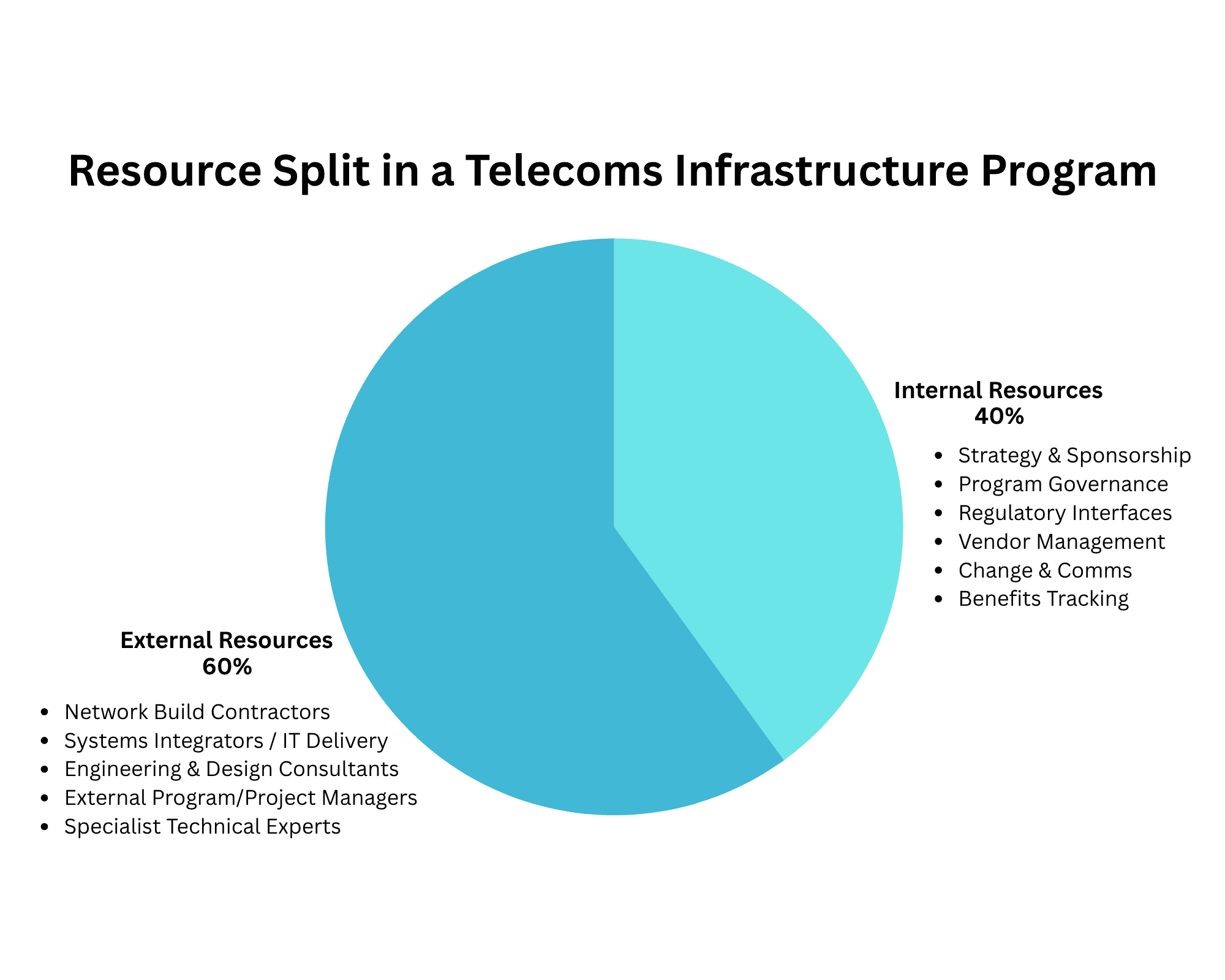
In program after program, suppliers are doing half the heavy lifting – sometimes much more. And yet, their mobilisation gets a fraction of the time and attention you give your own internal teams.
Governance is lighter. Scrutiny is shallower. Issues are slower to surface. By the time problems become visible, the damage is often done.
Too many organisations put their faith in big-name suppliers based on brand, reputation, or case studies from other geographies.
Contracts are signed. Kick-off meetings are held. And then – the curtain drops. Who’s actually turning up to do the work?
You might be surprised.
A Familiar Trap
Some years ago, my company was handed delivery responsibility for a major program to launch a new operator. Two heavyweight suppliers were already on board:
· A global IT giant, contracted to deliver billing, customer care, provisioning – the core OSS/BSS stack
· A major infrastructure vendor to handle the equipment and fibre rollout
When I asked the CEO why these vendors had been chosen, he said, “They did this exact job overseas – proven track record.”
But what we saw didn’t reflect that. Delivery was behind. Development had gaps. Testing was underwhelming. Integration was messy. It looked like a team learning on the job.
I asked the IT supplier to introduce me to the people who’d worked on the original deployment. The Account Director was hesitant – and now I understand why.
After much persuasion, he took me to a floor of around 60 people. Only two had worked on the supposed “identical” program.
In other words: the case study was real. But the people who’d delivered it were long gone.
The Same Pattern, Worldwide
This isn’t rare. I’ve seen the same pattern with suppliers based in the US, India, South Korea, Germany, and the Nordics.
The pitch is persuasive. The senior execs are credible. But the delivery model is flimsy:
· The “A team” is elsewhere – usually back at HQ
· Delivery is staffed by whoever’s available – often agency contractors re-badged as the supplier’s own
· There’s little or no continuity with the previous job that helped win the contract
Software-based product solutions provide sophistication and flexibility. However, they also add layers of complexity, including mismatches between roadmap and actual capability, subtle performance behaviours, and obscure side-effects from customisations.
All too often, project teams work only from sales collateral and fail to appreciate the real intricacies.
Of course, some suppliers do better. They escalate early. They bring real expertise. They act like partners.
But they are the exception.
Most say yes too early, mobilise too slowly, and only realise they’re underwater once the program is already in trouble.
And by then, the people who sold you the vision are long gone.
Where Governance Breaks Down
This is the blind spot. Internal workstreams get scrutiny. Supplier workstreams get trust.
You’d never let your internal teams run without structure, clarity, or oversight. But somehow, when the delivery sits outside your own org chart, that discipline fades badly.
Suppliers never surface bad news early. When they do, it’s usually because the issue is already public – and even then, the updates can be vague, sanitised, and late.
Governance often finds out when it’s too late to course-correct.
What You Can Do Right Now
If your program depends on critical supplier workstreams, these steps matter:
· Mobilise – don’t just contract. Go beyond the legal framework. Ensure the supplier’s mobilisation plan is as robust as your own.
· Insist on named individuals. Who is actually doing the work? Where are they based? What have they done before?
· Interrogate the case study. How many people from the “identical” job are on this job? Get names, not warm words.
· Understand the delivery model. Are you getting in-house talent, or contractors from a local agency with different incentives?
· Agility is no excuse for lax discipline. Design integrity, configuration management, security, testing, and operability remain essential and must be owned and executed end-to-end.
· Systems integration teams working with software-based products need a direct line to genuine product experts – authentic product managers and, when necessary, product developers. Sourcing systems integration from the product developer can mitigate risk, but only if access to product expertise is direct rather than via sales liaison.
· Apply equal scrutiny. Mirror your internal governance standards. Supplier workstreams should be held to the same yardsticks.
· Clarify escalation. Who can escalate? Can they make decisions? Or does it all reroute to a remote HQ in a different geography?
· Keep focus on actual business value: while technology deliverables are crucial, the accompanying marketing, sales, operational and customer-support capabilities are equally important.
Final Thought
You wouldn’t sign off on your own team’s plans based on someone else’s CV.
Don’t do it with your suppliers either.
Every month, we see companies suing their suppliers for misrepresentation and non-performance.
It’s not just about money – it’s about missed deadlines, lost trust, and reputational risk.
Put real effort into supplier mobilisation. Treat it as seriously as you treat internal mobilisation – maybe more so.
Because when it goes wrong, liquidated damages won’t save your program.
And the “A team” you thought you hired may be working on something else – somewhere else – for someone else.
About the author
David Hilliard is founder of Mentor, specialists in strategic program execution.
You can call him on 0118 359 2444 or email david.hilliard@mentoreurope.com.