The Moment Synergies Really Fail – And Why No One Sees It Coming
A pattern seen across major Telco integrations – and in almost every large program where synergy assumptions harden too early.
1. The Sacred Spreadsheet
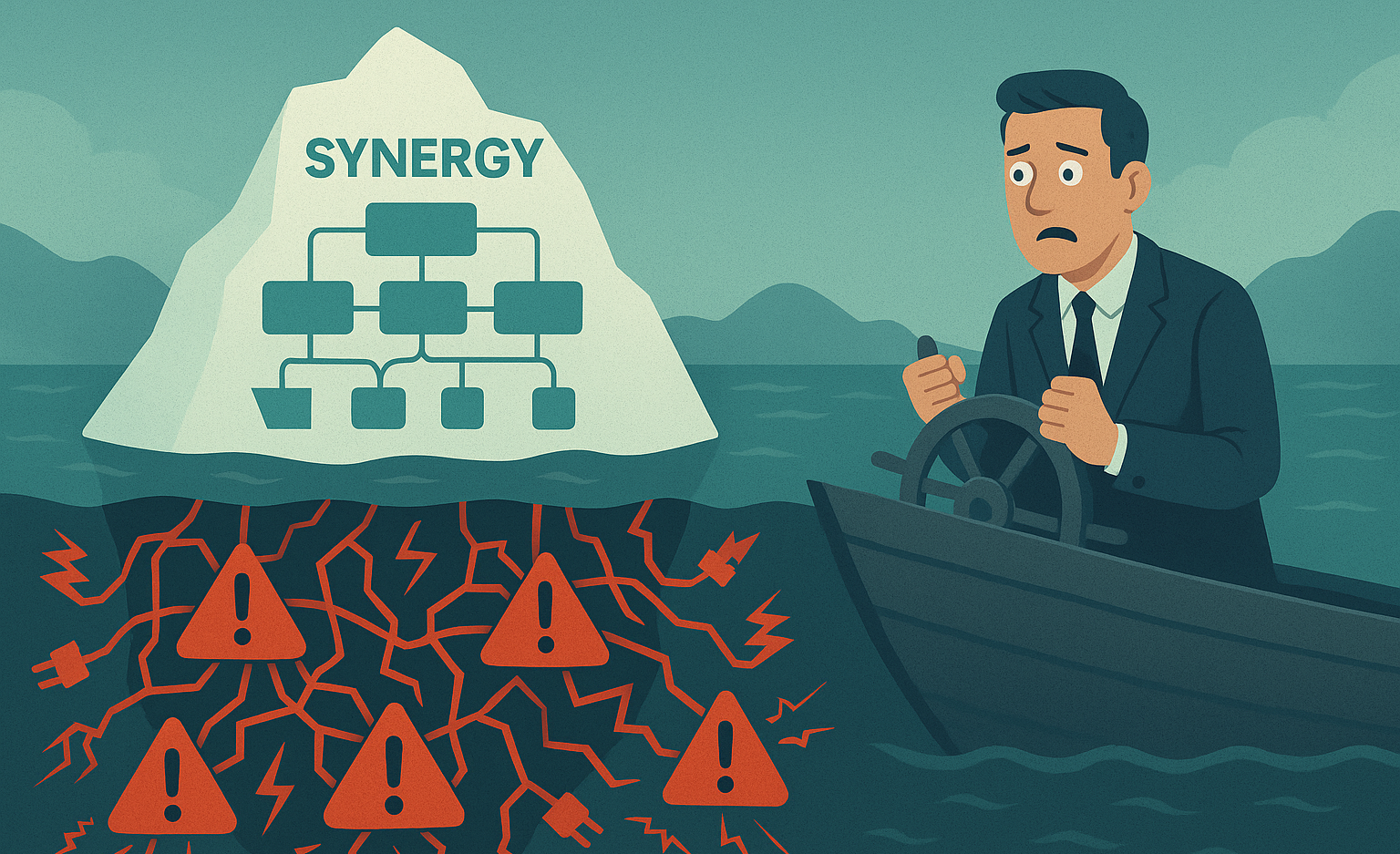
Most mergers don’t fail in integration. Most major programs don’t fail in execution. They fail much earlier – at the moment a few untested numbers in a spreadsheet becomes sacrosanct.
We’ve seen this moment more times than we can politely admit. It is always calm. Always civilised. Someone invariably says, “Tight but achievable,” which is how polite companies agree to overlook risk.
A synergy number is presented with cool confidence, as if certainty were the same as truth. A key dependency is waved away. A milestone is declared “non-negotiable.” And with a gentle collective nod, everyone agrees to suspend disbelief. No one intends mischief. But confidence hardens long before truth catches up and this is where slow-motion failure begins in both M&A and major programs.
2. The Seductive Story
Every failed merger begins with a striking story about synergies, scale, or strategic advantage – a story the value case depends on.
Every failed program begins with a similarly attractive story about transformation, simplification, or modernisation.
Different words. Same illusion.
Once a story becomes popular, evidence becomes optional. After a few rounds of leadership alignment, everyone knows exactly what the truth ought to be – a version usually at odds with what the truth is.
By the time someone finally asks, “Do we actually know this?” the story has too much momentum to stop.
3. The Ownership Mirage
You would expect a multi-million-pound merger or a high-stakes transformation to have a single, unmistakably accountable owner. Instead, ownership begins to resemble a chamber orchestra in which everyone is first violin.
Committees multiply. Responsibilities blur. Decision rights drift into ceremony rather than action.
Executives describe themselves as “fully accountable,” which in corporate language often means: “I’m not entirely sure who is, and I sincerely hope it isn’t me.”
4. The A-Team and the B-Team
One of corporate life’s unspoken rules is simple: the A-team negotiates the deal or defines the strategy – and the B-team inherits the delivery.
The A-team is sharp, strategic, and already thinking about the next frontier. The B-team is dedicated, capable, and chosen mainly for availability.
It’s like hiring Michelin-star chefs to design the menu and asking weekend volunteers to run the kitchen.
No ill intent – just a fundamental mismatch between ambition and execution power. And once the wrong team is at the wheel, even a good strategy begins to fight against itself.
5. The Two-Year Rule
There is another pattern everyone close to the action knows but few write down: very few leaders stay more than two years into a major merger or major program.
And if you’re close enough to see how things are unfolding, you can already picture who won’t still be in the room when the real tests arrive.
People close to the work start having those quiet conversations early. It isn’t malicious. It’s simply an acknowledgement of how these stories tend to unfold.
Some leaders are pushed. Some are promoted sideways. Some quietly leave before the market discovers that the value case has entered palliative care. It’s rarely personal. It’s almost always structural.
When the starting assumptions were wrong, the people who made them rarely remain long enough to face the consequences – except for the occasional individual serenely convinced they were right all along.
The teams, however, stay. They absorb the turbulence. They inherit the assumptions. They reconcile the promises of Year 0 with the realities of Year 2. They are the ones who know the truth long before it becomes visible to everyone else.
6. When Reality Arrives
Plans are rational. Delivery rarely is.
Under pressure, human behaviour takes over. Decisions reopen. Turf is defended quietly but firmly. Approvals slow to a crawl. People smile warmly in meetings, then continue with their original plan. Slide decks stay aligned; the teams themselves do not.
This isn’t dysfunction. It’s human nature arriving right on cue – and unmanaged, it unravels even the most carefully engineered plans.
7. The Cost of Looking Away
In the end, it’s not integration plans or program structures that determine success. It’s whether the organisation is willing to confront the truths buried in the spreadsheet. Most never do – and everything that follows is simply the price of looking away at the moment it really mattered.
None of this is inevitable…
But synergies are lost – early and with certainty – when no one is empowered to test the comforting assumptions underpinning the value case.
The organisations that thrive are the ones that choose to look early, look hard, and look independently.
About the author
David Hilliard is founder of Mentor, specialists in strategic program execution.
You can call him on 0118 359 2444 or email david.hilliard@mentoreurope.com.