
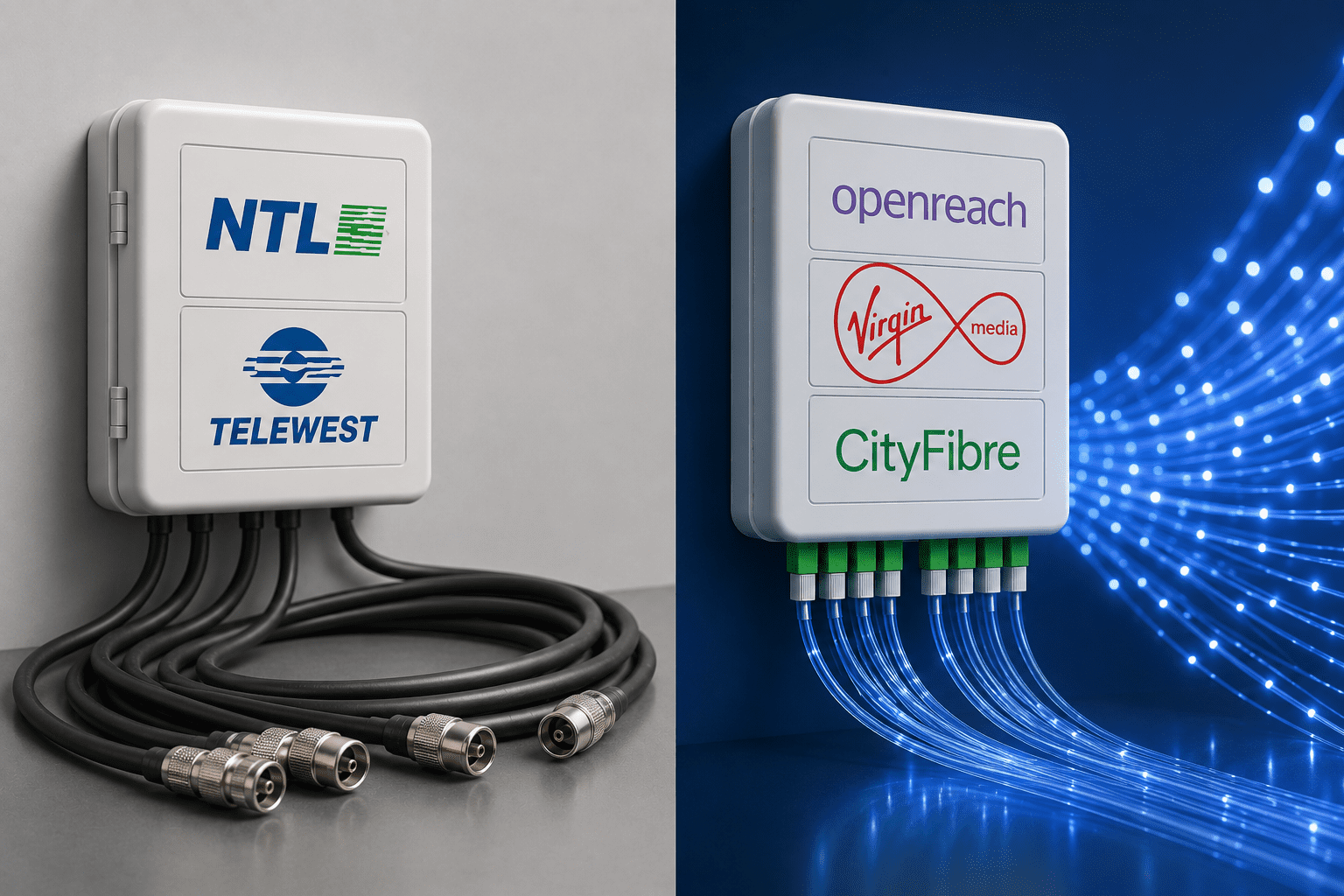
The UK Cable Industry Already Taught Us What Happens Next in Fibre
Yesterday’s ISPA event in London was dominated by one subject: consolidation.
The UK fibre market was built during an era of abundant capital, aggressive expansion and enormous optimism. Parallel infrastructure deployment was treated as momentum rather than inefficiency. Speed mattered more than operational discipline.
Now the environment is changing.
Capital is more expensive. Customer acquisition costs are rising. Overbuild is becoming harder to ignore. Increasingly, the debate is shifting away from pure expansion and toward sustainable scale.
Which is why consolidation now feels less like a possibility and more like the likely direction of travel.
Parts of the industry already seem to have formed a fairly clear picture of the eventual end-state:
- Openreach as the dominant infrastructure player
- Virgin Media O2 and nexfibre pushing aggressively for leadership scale rather than settling for a permanent also-ran position
- CityFibre emerging as one of the principal consolidators
Perhaps that is broadly where the market lands.
And in many ways, that could prove very positive for the long-term health of the sector. The UK fibre market was never going to support well over 100 infrastructure players indefinitely once capital markets tightened and operational economics started mattering more than footprint ambition alone.
But listening to the discussion yesterday also brought back strong memories of another British infrastructure industry that once went through a remarkably similar cycle.
The UK cable industry.
Who remembers the endless PIA wars? The blocked duct arguments? The accusations of operational foot-dragging? The conference panels that felt permanently stuck in arguments about civils costs, access and whether meaningful infrastructure competition would ever really be allowed to happen?
Or the endless battles around Virgin Media’s HFC strategy versus “real” full fibre?
At times, the sector felt locked in a permanent low-grade infrastructure civil war.
Fast forward to today and the picture looks very different. Openreach has become one of the largest fibre deployment engines in Europe. Virgin Media O2 and nexfibre now sit at the centre of the next major infrastructure scale debate. Meanwhile, the altnet market itself is entering a phase where operational scale and consolidation increasingly dominate the conversation.
Which is a useful reminder that industries rarely evolve in neat straight lines.
The UK cable industry also taught us something else.
The transactions are only the beginning.
What followed NTL, Telewest and the cable consolidation era were some extraordinarily difficult multi-year integration programs involving networks, OSS/BSS platforms, customer migrations, supplier rationalisation, inherited technical debt and fragmented operating models.
Some systems remained partially disconnected for years because the operational risks of forcing rapid convergence were simply too high.
And that may prove to be one of the biggest lessons for the fibre market today.
Because these are anything but ordinary transformation exercises.
Very few people have actually done integrations at this scale before.
The problem is not that complexity increases.
The problem is that it compounds faster than organisations can absorb it.
History tells us this may turn out to be less a consolidation story – and more a brutal test of large-scale execution capability.
Buying the assets will turn out to be the easy part.
Keeping the whole thing working while everything underneath is being ripped apart and rebuilt is where the real test begins.
About the author
David Hilliard is Founder of Mentor, execution specialists in strategic program execution.