

Where Is The Miracle In The Latest ESN Transition Plan?
In Sidney Harris’s famous 1977 cartoon, two scientists stand in front of a blackboard covered in equations. Between one set of workings and the next are the words: “Then a miracle occurs.”
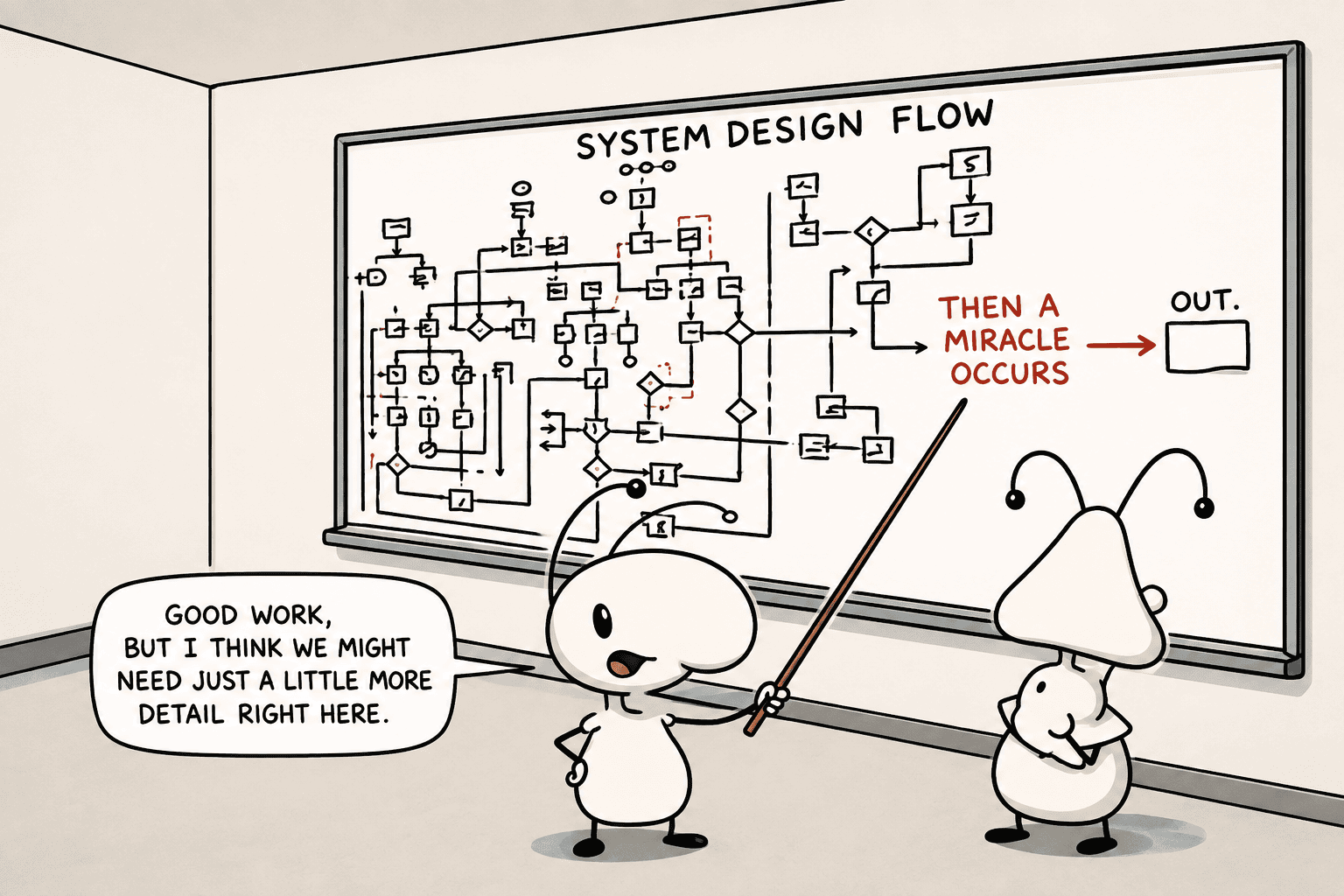
The joke is not that everything on the board is wrong. It is that the most important step has not been explained.
That is a useful way to look at the latest plan for moving Britain’s emergency services from Airwave to the Emergency Services Network (ESN).
John Black, ESN Program Director, has now set out the broad route from the current program to mass transition. His latest outline suggests that ESN is moving into a different phase.
For most of ESN’s life, the dominant question has been whether the system itself would ever work. That question has not disappeared, but the critical path is shifting from proving the system – to preparing and moving the organisations that must use it.
These are two distinct undertakings.
The first is to build, integrate and prove ESN. The second is to make more than 100 police, fire and ambulance organisations ready to depend upon it – and then move them safely from Airwave within the proposed timetable.
The broad sequence is clear enough. ESN is expected to reach Full Voice Service Ready in March 2028. Operational pilots and User Organisation approvals would follow, with mass transition beginning in the fourth quarter of that year.
The plan is then to move around 350,000 users, 45,000 vehicles and more than 100 police, fire and ambulance organisations onto ESN within 18 to 21 months.
That may be achievable.
But what would need to be true for it to happen?
System readiness is not deployment readiness
The distinction matters because a system can be technically ready without the organisations expected to use it being ready to depend on it.
Full Voice Service Ready cannot simply mean that the central system has met a technical definition. It must be sufficiently stable and proven for front-line organisations to make operational decisions around it.
Coverage, resilience, voice quality, interoperability, control-room integration, service management and support will all need to hold under the conditions in which the emergency services actually operate.
The timetable appears to leave only a limited period between Full Voice Service Ready and the start of mass transition. The service will therefore need to be operationally mature when the milestone is reached.
The pilots that follow must confirm the operating model – rather than expose defects requiring major redesign, remediation or extended retesting.
Pilots are intended to find what earlier testing has missed. The plan therefore depends on them being realistic enough to provide confidence without revealing anything serious enough to move the timetable.
That is a demanding assumption.
But even if the system performs as intended, that does not complete the transition. More than 100 User Organisations must also make their control rooms, fleets, devices, people, procedures, support arrangements and governance ready to leave Airwave.
Police, fire and ambulance organisations cannot wait until Full Voice Service Ready before beginning that work.
There is a further complication. ESN will not be entering the emergency-services environment that existed when the program began.
During the years of delay, police, fire and ambulance organisations have continued to replace equipment, develop new operational capabilities and introduce alternative data and communications arrangements. Some of those changes were necessary precisely because ESN was not available.
The question is therefore not simply whether User Organisations will be ready to adopt ESN. ESN must also be ready to accommodate the systems, capabilities and operating practices they have developed in the meantime.
That creates a fluid baseline. Requirements agreed earlier in the program may no longer be sufficient, and facilities introduced locally cannot simply be discarded because they were not anticipated in the original design.
They must either be incorporated into ESN, integrated with it or replaced by something demonstrably better before an organisation can reasonably be expected to move.
By then, control-room integration, fleet planning, device deployment, training, operational procedures, support arrangements and local approvals will need to be well advanced.
For the timetable to hold, a substantial part of the transition must take place while ESN itself is still being completed and tested.
The program says that technical onboarding and local readiness work are under way.
What is much less clear from the information available publicly is how far that work has progressed across the whole national population, whether it is being managed to a common standard and whether enough organisations will be ready when the migration sequence requires them.
The visible signals from the emergency services are mixed. Fire and ambulance services show some evidence of preparatory activity, including work on local readiness, control rooms, vehicles and communications equipment.
The signals from the police are weaker. The available public material is dominated less by evidence of operational mobilisation than by concern over timing, equipment costs, funding and the consequences of further delay.
That does not prove that little work is taking place inside individual forces. Much of it may not be visible publicly. But the available evidence does not yet show police adoption gathering momentum.
That matters because policing is likely to represent the largest, most operationally varied and most politically exposed part of the transition.
Why transition is often the harder part
One of my favourite lines when running large programs was to tell the assembled company:
“It’s my job to get as many people working on the critical path as possible. It’s your job to get off it.”
The point was not simply to concentrate resources. It was to make every team understand whether it was helping the critical path move – or becoming part of the delay.
That distinction will matter enormously in ESN. With more than 100 User Organisations, multiple suppliers and thousands of interdependent readiness decisions, the critical path will move repeatedly. The program must be able to identify where it has moved, put the right capability against it and remove dependencies – before they become constraints.
Completing the technology and achieving the operational outcome are not the same thing.
Once the technology begins to mature, the remaining risk becomes dispersed across thousands of operational decisions: control rooms, vehicles, devices, training, procedures, sequencing, local readiness and authority to proceed.
None of those decisions will be especially difficult on their own. The challenge is making all of them converge – at the right time – without compromising operational safety.
That is particularly important in ESN because the emergency services are not one centrally managed organisation.
Police forces, fire and rescue services and ambulance organisations have their own leaders, governance arrangements, suppliers, operational pressures and tolerance for risk.
Each will need to be satisfied that ESN is ready for its particular circumstances before agreeing to leave Airwave.
The Home Office can provide the service, the evidence, the plan and the support. It can coordinate migration and encourage organisations to move.
What it cannot do is create operational confidence by decree.
The national timetable therefore depends on a large number of local decisions being made at roughly the points required by the central plan.
One organisation may be technically ready but unwilling to approve transition. Another may be waiting for a control-room supplier. A third may face a fleet problem or an operational event that makes its allocated window impractical.
Each problem may be manageable on its own.
Together, they determine whether the national migration rate holds.
Can the migration rate hold?
An 18-to-21-month transition implies a very high and sustained rate of activity.
The program will need to know how many organisations, users, vehicles, devices and control-room environments can be moved at the same time. It will also need enough installers, trainers, testers, operational specialists and supplier capacity to maintain that rate.
The important figure is not the maximum rate under ideal conditions. It is the rate that can be sustained – after allowing for late equipment, unavailable staff, failed installations, defects, operational emergencies, supplier constraints and organisations that are not ready when expected.
Our work on ambulance control rooms, Channel 5, Digital Terrestrial Television, mobile and fibre networks repeatedly exposed the same constraint: delivery capacity cannot be measured simply by counting the number of people available.
Additional staff can be recruited through agencies or subcontractors, but that does not make them immediately productive. They first have to be trained in the technology, procedures and required standards, usually by the experienced people already needed to sustain the rollout.
The apparent increase in headcount can therefore reduce effective delivery capacity long before it improves it.
That is particularly important when a rollout is expected to accelerate quickly.
The program must know how many suitably skilled people are already secured, how many more will be required, how quickly they can become effective and how much experienced capacity will be consumed in training and supervising them.
Those people must also be available in the right places and at the points when each migration wave requires them.
The same applies to the organisations themselves. The program must know how many control rooms, vehicle fleets, device populations and groups of users can be prepared and migrated in parallel without stretching the available capacity or weakening operational control.
If the transition plan has been built on sustainable capacity, there should be a clear basis for the proposed migration rate and enough contingency to cope when individual moves slip – as they will.
A migration rate derived mainly by dividing the total population by the number of available months would not be enough. The plan must also show that the people, suppliers and User Organisations can sustain that rate under real operating conditions.
The early migrations must test the difficult cases
The first migrations will naturally involve organisations that are willing and reasonably well prepared.
That makes sense. Early success matters, and the transition process should accelerate as experience is gained.
But a smooth migration in favourable conditions does not necessarily prove that the national transition model will work.
The early waves need to reflect the variety of the overall population: different emergency services, control-room systems, fleet arrangements, geographies, suppliers and levels of organisational readiness.
Otherwise, the program may learn how to move the easiest organisations while discovering the more difficult constraints too late.
There will also be a period in which some organisations are using ESN while others remain on Airwave. That mixed environment must operate safely across regional and service boundaries.
There is an obvious incentive to keep dual running as short as possible. Airwave is expensive to maintain, and a prolonged transition adds both cost and complexity.
But moving too quickly creates a different risk. It may place pressure on organisations to migrate before they are genuinely ready.
The program therefore has to move quickly enough to limit dual running, while never allowing the national timetable to override operational judgment.
The program has very little room for error: move too slowly and the cost and complexity of dual running will escalate; move too quickly and services may be pressured to migrate before they are genuinely ready.
The transition must absorb what goes wrong
No transition of this scale will proceed cleanly from beginning to end.
Some moves will slip. Defects will emerge. Equipment will arrive late. Control-room integration will take longer than expected. Local organisations will encounter operational pressures that force them to postpone.
The test is not whether these things happen – they do.
It is whether the transition system can absorb them.
Can one organisation be moved to a later wave without disturbing several others? Is there spare supplier and installation capacity? Can defects be isolated? Can lessons from one migration be introduced without destabilising the next?
Are fallback arrangements genuinely usable?
A credible transition plan assumes that parts of it will go wrong.
The question then is whether the national sequence can still hold when they do.
Who owns and tests the whole plan?
Formal accountability exists within ESN.
The Home Office is accountable for the program. IBM, EE and other suppliers are accountable for their contracted responsibilities. User Organisations are accountable for their own readiness and operational decisions.
But that does not automatically create accountability for the whole transition.
The future program objective is no longer simply to complete the system. It is to orchestrate the safe movement of more than 100 independently governed emergency-service organisations onto it. Specifically:
- Who owns the point at which the central service, supplier activity and all those local plans must come together?
- Who decides how many organisations can safely migrate in parallel?
- Who validates readiness claims?
- Who resolves the conflict when a national date and a local operational judgment do not align?
- Who has the authority to slow the transition if the evidence no longer supports the planned rate?
- And – who is accountable for the assumption that the migration can be completed within 18 to 21 months?
There may be clear answers inside the program, but they are not clear from outside it.
ESN is subject to Home Office governance, Treasury scrutiny, government assurance and oversight by its Senior Responsible Owner. The National Audit Office and Public Accounts Committee have also examined the program repeatedly.
That is a substantial structure.
But the important question is what has actually been tested. For example:
- Has anyone independently reconstructed the transition plan from the bottom up?
- Have local readiness plans been reconciled against the national sequence?
- Have migration-rate assumptions been tested against real supplier and User Organisation capacity?
- Have control rooms, fleets, devices, training, approvals and Airwave dependencies been brought together on one controlled baseline?
- Has the plan been stress-tested against likely delays?
And, has anyone sufficiently independent been asked not simply whether the program is being governed, but whether the transition is likely to work?
Those are different questions.
Why the history matters
ESN has been in development for more than a decade.
The original expectation that Airwave would be replaced in 2019 disappeared long ago. The program has undergone repeated resets, its principal transition dates have moved several times and costs have risen by billions.
That history does not determine the outcome of the current plan. It does, however, raise the standard of evidence required before the latest timetable can command confidence.
So where is the miracle?
The miracle may not be one impossible task.
It may simply sit in the assumption that the service will be stable by March 2028, that the pilots will confirm rather than disrupt the plan, and that enough User Organisations will be ready to move.
It also assumes that local approvals will align with the national sequence, suppliers will sustain the required migration rate, Airwave and ESN will coexist safely, and inevitable problems can be absorbed without moving the final date.
None of those conditions is unreasonable on its own.
The challenge is that the plan appears to require all of them to hold together.
Perhaps the detailed transition machinery exists. Perhaps the assumptions have been tested, the local plans reconciled and the migration rate built from the bottom up.
The difficulty is that very little of this is publicly visible.
The question raised by the Sidney Harris cartoon is not whether the answer on the far side of the blackboard is wrong. It is whether the workings in the middle are strong enough to get there.
The defining delivery challenge for ESN is no longer only building the system. The critical path has moved to the transition itself.
John Black’s challenge is now to get all the essential people working on that critical path – and everyone else off it.
In a program of this scale, the critical path will move – repeatedly. The job is to recognise where it has moved, put the right capability against it and stop other parts of the program becoming obstacles.
He must do all of that while keeping the transition moving at pace and without compromising public safety.
Success will depend on whether those conditions can be made to hold together within the proposed timetable, and whether the program can show that they have been properly tested.
About the author
David Hilliard is Founder of Mentor, execution specialists in strategic program execution.